
For a PDF of this note, please click here.
As the dust from the US midterm elections settles and speculation abounds about the implications for critical material supply chains, there is a broader question that is not being asked or assessed. The vulnerabilities in the West around access to critical materials such as yttrium or graphite are well known. China maintains enormous leverage over the rest of the industrialized world given its dominance of these supply chains. It is taken as a given that this leverage is structural, though this is debatable. While the West’s weaknesses are laid bare by an endless stream of journalists and think tankers, what are China’s weaknesses and what are the implications for critical materials?
I think the leverage China possesses is not entirely structural but is finite. China’s weaknesses are macroeconomic in nature and mean that as those weaknesses persist, the current leverage the country maintains over the West is limited.
This is a key difference in the critical materials conflict between the West and China: China’s weaknesses including persistent deflation, an over-reliance on exports, demographics, and debt loads are not immediate problems that can be solved. They are macroeconomic in nature and if not addressed, can change the calculus of the geopolitical leverage with the rest of the world. The challenges the West faces with respect to critical materials are immediate in nature and not as dependent upon macroeconomic factors. Therein lies the difference: timing.
China needs to build domestic consumption to wean itself off an economic model dependent on exports and beset by deflation. In the absence of domestic demand, increased exports are a release valve for growth. Should China increase exports of critical materials, this will push prices down and render ex-China supply chains uneconomic. This is bad news for Western investors and the main reason why the trade war began in the first place. Looked at this way, China restricting supply (its main source of leverage) is a net benefit to Western critical material producers. Lifting export controls is the rational move for its own economy.
This essay briefly examines some of China’s challenges, what they mean for competition, and how the West can respond.
THE ALBATROSS OF DEBT
Much of Chinese growth has been fueled by debt in recent decades. Just how much debt has been issued is up for debate. Also, this isn’t necessarily an issue depending upon how the debt is used. If debt is used to build productive assets in an economy that can generate cashflows to service the interest and principal, this theoretically should lead to economic growth (as measured by GDP) and allow for that growth to be sustained. Should that debt be used to fund projects that don’t deliver an adequate return, governments can end up with a scenario we see in multiple countries currently: increased debt issued to service or pay off old debts. This has significant implications for borrowing costs and other metrics. While the US is certainly not a model of fiscal responsibility, China’s debt usage has become a burden on the long-term growth prospects of the economy. China’s government debt-to-GDP ratio currently stands at 104%, up from 41% in 2015. While debt loads have grown globally, what makes China different is a tendency to believe that data like this has been massaged and there is a significant amount of off-balance sheet debt issued by local government financing vehicles (LGFVs). When this debt is estimated and added in, the number soars higher, perhaps as much as 130% of GDP. This debt can stay hidden from balance sheets, making it difficult to get a clear sense of how indebted a Chinese company, or the country writ large, truly is. For the sake of comparison, US government debt-to-GDP is currently 127% and total debt-to-GDP registered at 265% last year. However, when combining China’s government, household, and corporate debt, the ratio explodes to 300% of GDP.
These numbers are certainly up for debate and won’t be litigated here. Given China’s slowing GDP numbers in recent years, more debt issuance appears to act as a drag on growth rather than an accelerant.
China has limited choices in terms of how to service trillions in debts, both public and private. These include economic growth, refinancing, or default. None of these three choices are entirely palatable, so China has chosen to grow through an investment and export model. The problem here is that there is a limit to domestic investment (you can only build so many apartment buildings, lithium refineries, or magnet factories) and there is a limit to exports (eventually, a flood of low-cost Chinese goods will impact jobs, wages, and growth in importing countries) which leads to the current trade war environment we are enmeshed in today.
With respect to debt-fueled growth, there are no easy answers here, but China’s traditional growth model has run its course. China needs foreign demand to grow its domestic economy out of a deflationary spiral just at the time when tariff barriers and reindustrialization are standing in the way.
EXCESS CAPACITY: STRENGTH OR WEAKNESS?
A consequence of unfettered domestic investment coupled with a mandate to dominate next-generation technologies is the overbuild of industrial capacity. While this can force plants to operate below stated capacity, it also depresses prices for goods and margins as an excess of supply crushes prices and margins. This is also the source of the current trade tensions across the globe. Western consumers like cheap stuff, but not at the expense of a hollowed out industrial base, lower wages, and domestic unemployment. This excess capacity also allows Chinese industry to produce almost any good at scale and at a speed that the West currently cannot match. Additionally, it is the excess production capacity in China that has made manufacturing a fiercely competitive battleground and suppressed prices globally for most goods.
It’s unlikely that Western producers will be able to meet the speed, scale, and most importantly price of Chinese manufacturers, so a higher end price and a structurally higher-cost supply chain are the results. It is still up for debate just how willing Western consumers are to pay a higher price for a good when the equivalent in China comes at a lower cost. The fact that China can dictate what can and can’t be exported should be enough of an impetus to strike fear in the heart of any supply chain manager. Recent moves by the US government such as price floors and guaranteed offtake agreements are a start towards embedding a price premium and re-establishing a manufacturing base.
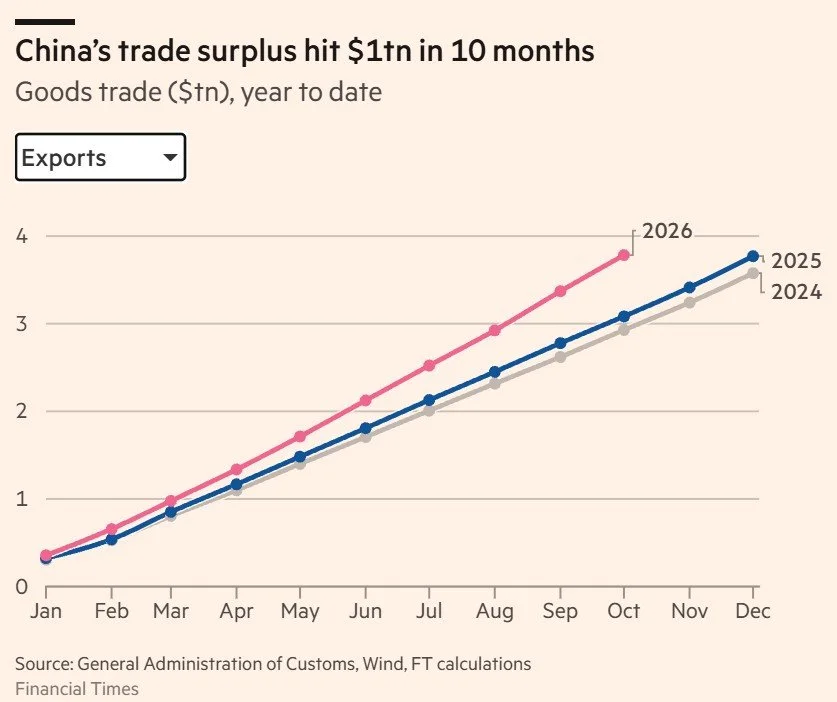
Excess manufacturing capacity in China is a boogeyman that has likely kept more investment out of the critical materials supply chain. How much excess lithium refining capacity truly exists in China? It’s certainly there, but to be honest, nobody knows for sure. This uncertainty is a strength for China until more industrial capacity can be built in the West. While this clock continues to tick, it may be a while before enough commercial-scale critical materials capacity can erode China’s edge.
WHAT ELSE?
There are other slow-moving forces that work against Chinese dominance and voluminous numbers of articles have been written on these topics. I just finished Logan Wright’s excellent book Broken China: How the Economic Miracle Shattered and What it Means for the World and would recommend it as a much deeper examination of some of the points made here. This short essay was designed to highlight some of the more notable catalysts for slower economic growth.
Demographics receives a great deal of press outside of China and was a major investment pillar in my piece titled The New Critical Materials Paradigm. When looking at age trees, it does seem likely that China will “grow old before she grows rich”. The removal of the One Child policy, implemented in 1979 and rescinded in 2016, is too little too late, as demographic tailwinds take at least a generation to have an impact on economic growth. This demographic cliff is likely a main reason behind President Xi’s efforts to boost investment in next generation technologies such as robotics that are labor-saving but also create significant IP.
Finally, given China’s outbound investment push as manifested by the Belt-and-Road Initiative (BRI), it was only a matter of time before countries put their foot down and started to demand more exposure to the full supply chain and its economic upside. Zimbabwe and Indonesia’s restrictions of raw ore exports for lithium and nickel are the two most obvious examples. The requirement for more domestic investment isn’t structural in the same way demographics or domestic malinvestment are but does serve to slow down China’s attempt to diversify its export-dependent economy. Rather than feeding possible excess capacity onshore in China, companies must now build the same capacity collocated with the ore in the host country. The time it takes to build isn’t the issue – China’s speed of execution is a hallmark of the country. The issue is the possibly redundant capacity and what that may mean for pricing and margins.
WHAT TO DO IN THE WEST?
So much of the future is policy-dependent. Demand seems to be a given, though we can argue the trajectory. But the trajectory is also partially policy-dependent!
The China bears would say that the country is slowly running out of options for sustained growth. With the timing of any structural change so lengthy, it’s perhaps a better idea to position based on the scenario analysis presented in my longer piece. As a reminder, these Four Futures are Overbuild (China adds supply and the West builds capacity on schedule), Two Systems (China continues to restrict supply but the West builds capacity on schedule), Reversion (China adds supply and the West fails to build capacity), and Siege (China continues to restrict supply and the West fails to build capacity).
Regarding the Overbuild scenario, China must export to grow, and so adding to global supply would benefit those downstream users (automotive, for example) that would readily purchase cheap Chinese components, subject to Western governments allowing this. As Western supply in this scenario also comes to market, the economics come into question as it must compete with cheap material from China. The only factor preventing Western end users using Chinese material is Western policy in the form of tariffs or other controls. A Western price premium in this scenario is crucial for Western producers. But will Western end users pay up?
With the Two Systems scenario, China’s growth would only survive if domestic demand compensated for the lost revenue from restricted exports to the West. Bifurcated pricing becomes cemented in place and inflation and cost structure in the West remain elevated though this can support a Western premium. This would be the most optimal of the four scenarios.
Reversion is the scenario China is hoping for. If Western players can’t establish industrial capacity on time and on budget, Chinese supply of magnets, batteries, and the like will be needed irrespective of Government diktat. China can open and shut off supply at will. This is where Western industrial policy goes to die.
With the Siege scenario, a permanent shortage of materials becomes the general resting state in the critical materials ecosystem with China keeping supply off the markets and the West unable to build capacity. In this scenario, the Western investor would want to own the upstream (mines and refineries) as producing any downstream materials like magnets becomes impossible without a steady supply of refined material regardless of your geography.
The key in all these scenarios is price. Regardless of whether a market is structurally bifurcated, unless a Western price is contracted, it will be hard to enforce and won’t match the price of the same molecule out of China.
CONCLUSION
As the well-known economist and China expert Michael Pettis writes, competitive and comparative advantage are not the same thing. China’s historical competitive advantage has been rooted in several factors including state-driven subsidies, fierce domestic price wars, and a focus on export-driven growth which has led the country to dominate global supply chains as the lowest-cost producer of many goods. My case above is that these and other drivers of growth are fading and distorting China’s comparative advantages.
The weaknesses in China’s model are macro stresses, like tectonic plates pushing up against each other. If one plate is Chinese supply, the other plate is Western demand. Both forces cannot grow in perpetuity without an eventual collision (like a trade war). The best thing that can happen in the West as trade truces are extended endlessly, is for the buildout of industrial capacity to move forward through subsidies like price floors, investments, and partnerships. This is certainly not the traditional Western economic model of growth, but as I have maintained, we are not going back to the way things were.